
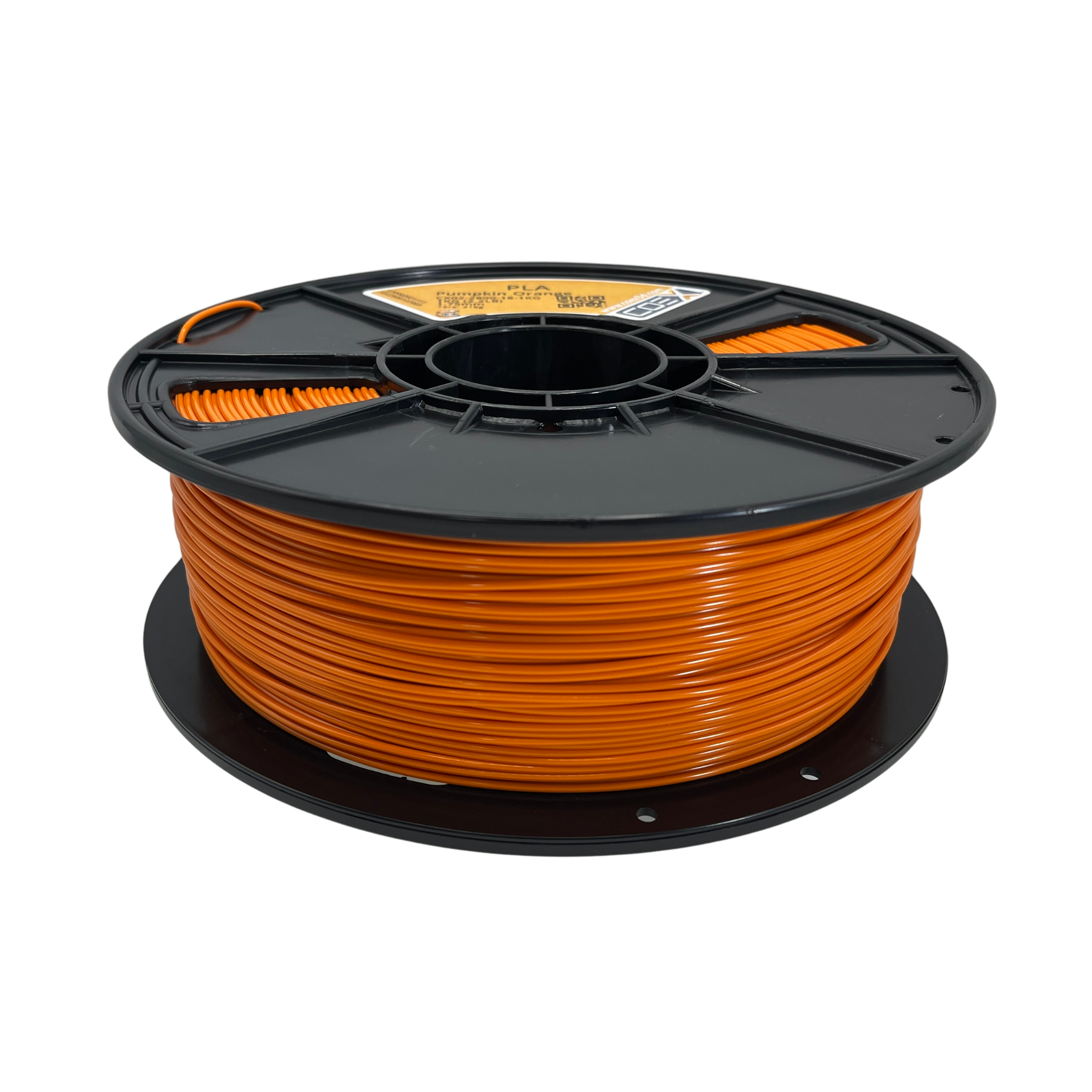


Pumpkin Orange PLA is a warm orange, the color of a ripe pumpkin. Use it for Halloween props and fall decor, or for tags, organizers and other parts you want to stand out. For Halloween, pair it with Neon Green. Want another orange? See Inferno Orange.
Like all COEX 3D Standard PLA, it's made in our Green Bay, Wisconsin facility from virgin NatureWorks Ingeo 4043D resin (colorant only, no fillers) and held to ±0.03mm (1.75mm) or ±0.06mm (2.85mm) diameter on every spool.
Need stronger parts? Pumpkin Orange also comes in 1.75mm PLA Prime, which prints much like Standard PLA but is significantly stronger once annealed (heat-treated after printing).
Specs
- Material: Standard PLA, NatureWorks Ingeo 4043D
- Tolerance: ±0.03 mm (1.75 mm) · ±0.06 mm (2.85 mm)
- Other spool sizes available by request: contact us.
- Vacuum-sealed with desiccant
- Backed by our defect guarantee: we replace or refund defective filament.
- Extruded, quality controlled and shipped from one plant in Green Bay, WI.
- Slicer profile: the COEX PLA profile for 1.75mm filament is built into OrcaSlicer 2.3.2 and later. In Filament Selection, choose vendor COEX 3D, then COEX PLA.
Print settings · Slicer profiles · Technical data sheet · Safety data sheet
CX02 PLA Technical Data Sheet
PLA 3D Printer Filament
PLA (polylactide) biopolymer · Product code CX02 · 1.75 mm and 2.85 mm
Base resin: PLA (polylactide) biopolymer
Typical values for the base resin. Printed parts vary with print settings, orientation and moisture content. Resin maker: typical properties for injection molded amorphous bars; not to be construed as specifications.
Physical properties
| Property | Standard | Unit | Typical value |
|---|---|---|---|
| Specific gravity / density | ASTM D792 | g/cc | 1.24 |
| Melt flow rate (MFR), 210 °C/2.16 kg | ASTM D1238 | g/10 min | 6 |
| Relative viscosity (1.0 g/dL in chloroform at 30 °C) | ASTM D5225 | 4.0 | |
| Peak melt temperature | ASTM D3418 | °C (°F) | 145–160 (293–320) |
Mechanical properties
| Property | Standard | Unit | Typical value |
|---|---|---|---|
| Tensile yield strength | ASTM D882 | MPa (psi) | 60 (8,700) |
| Tensile strength at break | ASTM D882 | MPa (psi) | 53 (7,700) |
| Tensile modulus | ASTM D882 | MPa (psi) | 3,600 (522,000) |
| Tensile elongation | ASTM D882 | % | 6 |
| Notched Izod impact | ASTM D256 | J/m (ft·lb/in) | 16 (0.3) |
| Flexural strength | ASTM D790 | MPa (psi) | 83 (12,000) |
| Flexural modulus | ASTM D790 | MPa (psi) | 3,800 (551,000) |
Thermal properties
| Property | Standard | Unit | Typical value |
|---|---|---|---|
| Glass transition temperature (Tg) | ASTM D3418 | °C (°F) | 55–60 (131–140) |
| Heat distortion temperature @ 66 psi (0.45 MPa) | ASTM E2092 | °C (°F) | 55 (131) |
Filament specifications
| Diameter | Nominal | Minimum | Maximum | Tolerance |
|---|---|---|---|---|
| 1.75 mm | 1.75 mm (0.0689 in) | 1.72 mm (0.0677 in) | 1.78 mm (0.0701 in) | ±0.03 mm (±0.0012 in) |
| 2.85 mm | 2.85 mm (0.1122 in) | 2.79 mm (0.1098 in) | 2.91 mm (0.1146 in) | ±0.06 mm (±0.0024 in) |
Recommended print settings
| Nozzle temperature | 220–240 °C |
| Bed temperature | 0–60 °C |
| Part cooling fan | Up to 100%, off for the first layer |
| Drying | 55 °C for 3–6 hours |
www.coex3d.com · COEX LLC, 1228 Elizabeth St, Green Bay, WI 54302, USA · (920) 757-1055
Disclaimer: The technical data contained on this data sheet is furnished without charge or obligation and accepted at the recipient's sole risk. This data should not be used to establish specification limits or used alone as the basis of design. The data provided is not intended to substitute any testing that may be required to determine fitness for any specific use.
CX02 PLA Safety Data Sheet
PLA 3D Printer Filament
PLA (polylactide) biopolymer · Product code CX02
1. Identification
| Product identifier | PLA 3D Printer Filament |
| Product code | CX02 |
| Recommended use | 3D printing (FFF/FDM) filament, thermoplastic |
| Restrictions on use | Not specified |
| Supplier | COEX LLC, 1228 Elizabeth St, Green Bay, WI 54302, USA |
| Telephone | (920) 757-1055 |
| Emergency telephone | (920) 757-1055 (business hours) |
| Website | www.coex3d.com |
2. Hazard identification
| Classification | This product is NOT classified according to 29 CFR 1910.1200 Hazard Communication Standard 2012. |
| Label elements | Signal word: None. Hazard Statements: None. Precautionary Statements: None. |
| Hazards not otherwise classified | May form combustible dust concentrations in air if small particles are generated during further processing, handling or by other means. Refer to protective measures listed in Sections 7 and 8. |
| Other information | Potential health effects: See Section 11 for more information. Environmental precautions: See Section 12 for more information. |
3. Composition / information on ingredients
| Chemical name | CAS No. | Weight % |
|---|---|---|
| Polylactide resin | 9051-89-2 | > 98 |
OSHA exposure limits: None. ACGIH exposure limits: None. All ingredients in quantities > 1.0% (0.1% for carcinogens) that are potentially hazardous per OSHA definitions. This material can generate Particulates Not Otherwise Classifiable (PNOC). The Occupational Safety and Health Administration (OSHA) PEL/TWA for PNOC is 15 mg/m3 for total dust and 5 mg/m3 for the respirable fraction. The American Conference of Governmental Industrial Hygienists (ACGIH) TLV/TWA for PNOC is 10 mg/m3 for inhalable particulates and 3 mg/m3 for respirable particulates.
4. First-aid measures
| Inhalation | Move to fresh air. Call a physician immediately. |
| Eye contact | Rinse immediately with plenty of water, also under the eyelids, for at least 15 minutes. Call a physician immediately. |
| Skin contact | Adverse effects are not expected from accidental skin contact following occupational exposure. After contact with skin, wash immediately with plenty of water. If skin irritation persists, call a physician. Cool skin rapidly with cold water after contact with hot polymer. DO NOT attempt to remove hot polymer from skin or contaminated clothing as skin may be easily damaged. Call a physician immediately. |
| Ingestion | Drink water as a precaution. Never give anything by mouth to an unconscious person. Do not induce vomiting without medical advice. Call a physician immediately. |
| Most important symptoms | No data available |
| Note to physicians | Treat symptomatically. |
5. Fire-fighting measures
| Suitable extinguishing media | Suitable extinguishing media: Foam, Water, Carbon dioxide (CO2), Dry chemical. Alcohol resistant foams are preferred if available. General-purpose synthetic foams (including AFFF) or protein foams may function, but much less effectively. Unsuitable extinguishing media: None known. |
| Special hazards | Under fire conditions: Cool containers / tanks with water spray. Water mist may be used to cool closed containers. Dust deposits should not be allowed to accumulate on surfaces, as these may form an explosive mixture if they are released into the atmosphere in sufficient concentration. Avoid dispersal of dust in the air (i.e., clearing dust surfaces with compressed air). Flammability: Autoignition temperature: 388 °C. Flammable limits in air - lower (%): Not applicable. Flammable limits in air - upper (%): Not applicable. |
| Protective equipment | As in any fire, wear self-contained breathing apparatus pressure-demand, MSHA/NIOSH (approved or equivalent) and full protective gear. |
| Further information | Dispose of fire debris and contaminated extinguishing water in accordance with official regulations. |
6. Accidental release measures
| Personal precautions | Spilled filament or pieces may cause a slipping hazard. Ensure adequate ventilation. |
| Environmental precautions | Do not flush into surface water or sanitary sewer system. Keep out of waterways. |
| Cleaning up | Pick up or sweep up and place in a suitable container for disposal. |
7. Handling and storage
| Safe handling | Use personal protective equipment as required. Avoid contact with skin and eyes. Low hazard for usual industrial or commercial handling. Workers should be protected from the possibility of contact with molten material during fabrication. Avoid dust formation. May form combustible dust concentrations in air if small particles are generated during further processing, handling or by other means. |
| Fire and explosion | Dust from grinding or sanding can form an explosive mixture with air. Take precautionary measures against static discharges. |
| Storage | Store at temperatures not exceeding 50 °C / 122 °F. Keep cool. No special restrictions on storage with other products. |
| Incompatibilities | Oxidizing agents, Strong bases |
8. Exposure controls / personal protection
| Exposure limits | Not established. This material can generate Particulates Not Otherwise Classifiable (PNOC). The Occupational Safety and Health Administration (OSHA) PEL/TWA for PNOC is 15 mg/m3 for total dust and 5 mg/m3 for the respirable fraction. The American Conference of Governmental Industrial Hygienists (ACGIH) TLV/TWA for PNOC is 10 mg/m3 for inhalable particulates and 3 mg/m3 for respirable particulates. |
| Engineering controls | Provide exhaust ventilation if dust or fumes are generated during processing. |
| Personal protection | Engineering measures: Where reasonably practicable this should be achieved by the use of local exhaust ventilation and good general extraction. Provide appropriate exhaust ventilation at places where dust is formed. Eye protection: Safety glasses with side-shields. Goggles. Skin and body protection: Impervious clothing. Respiratory protection: Respirator must be worn if exposed to dust. Wear respirator with dust filter. Respiratory protection is needed if any of the exposure limits in Section 3 are exceeded. Consult an industrial hygiene professional prior to respirator selection and use. Use a postive-pressure air supplied respirator if there is any potential for an uncontrolled release, exposure levels are not known, or any other circumstances where air-purifying respirators may not provide adequate protection. WARNING: Air purifying respirators do not protect workers in oxygen-deficient atmospheres. Hand protection: Preventive skin protection. Hygiene measures: Avoid contact with skin, eyes and clothing. Special hazard: Workers should be protected from the possibility of contact with molten material during fabrication. |
| Hygiene | Do not eat or drink while working. Handle in accordance with good industrial hygiene and safety practice. |
9. Physical and chemical properties
| Appearance | Solid; pellets, clear, translucent, opaque (Color: Clear, Translucent, Opaque) |
| Odor | Sweet |
| Odor threshold | Not applicable |
| pH | Not applicable |
| Melting temperature | 150-180 °C (302-356 °F) |
| Freezing point | No data available |
| Boiling point | Decomposes; not determined |
| Flash point | Not determined |
| Evaporation rate | Not applicable (solid) |
| Flammability | Fine dust dispersed in air may ignite |
| Explosive limits | No data available |
| Vapor pressure / vapor density | No data available |
| Density | 1.24 g/cc |
| Solubility in water | Water solubility: Insoluble. Solubility in other solvents: Not determined. |
| Partition coefficient | No data available |
| Auto-ignition temperature | 388 °C |
| Decomposition temperature | 482 °F (250 °C) |
| Viscosity | Not applicable (solid) |
| Oxidizing properties | No data available |
10. Stability and reactivity
| Reactivity | None under normal use conditions. |
| Chemical stability | Stable under recommended storage conditions. |
| Hazardous reactions | None under normal use conditions. |
| Conditions to avoid | Temperatures above 446 °F (230 °C). Avoid keeping resin molten for excessive periods of time at elevated temperatures. Prolonged exposure will cause polymer degradation. |
| Incompatible materials | Oxidizing agents, Strong bases |
| Hazardous decomposition products | Burning produces obnoxious and toxic fumes, Aldehydes, Carbon monoxide (CO), carbon dioxide (CO2) |
11. Toxicological information
| Routes of exposure | Inhalation, ingestion, eye or skin contact. |
| Acute toxicity | Principle routes of exposure: Eye contact, Skin contact, Inhalation, Ingestion. Acute toxicity: There were no target organ effects noted following ingestion or dermal exposure in animal studies. Skin: LD50/dermal/rabbit > 2000 mg/kg. Ingestion: Oral LD50 (rat) > 5000 mg/kg. |
| Inhalation | Not inhalable in the form supplied. |
| Irritation | Local effects: Product dust may be irritating to eyes, skin and respiratory system. Resin particles, like other inert materials, are mechanically irritating to eyes. Ingestion may cause gastrointestinal irritation, nausea, vomiting and diarrhea. Specific effects: May cause skin irritation and/or dermatitis. Ingestion may cause gastrointestinal irritation, nausea, vomiting and diarrhea. Inhalation of dust may cause shortness of breath, tightness of the chest, a sore throat and cough. Burning produces irritant fumes. |
| Sensitization, repeated dose, mutagenicity, carcinogenicity, reproductive toxicity | Long term toxicity: Did not cause skin allergic reactions in skin sensitization studies using guinea pigs. Mutagenic effects: Not mutagenic in AMES Test. Reproductive toxicity: No data is available on the product itself. Carcinogenic effects: This product does not contain any carcinogens or potential carcinogens as listed by OSHA, IARC or NTP. Target organ effects: There were no target organ effects noted following ingestion or dermal exposure in animal studies. |
| Aspiration hazard | None expected. |
12. Ecological information
| Aquatic toxicity | Ecotoxicity effects: EC50/72h/algae > 1100 mg/L. Mobility: No data available. |
| Persistence and degradability | Inherently biodegradable under industrial composting conditions |
| Bioaccumulation | Not expected to bioconcentrate or bioaccumulate. |
13. Disposal considerations
| Product | Dispose of in accordance with local, state and federal regulations. Check for recycling options. Do not release into the environment. |
| Packaging | Empty spools and packaging can be recycled if not contaminated. |
14. Transport information
| US DOT, IMDG, IATA/ICAO | U.S. DOT: Proper shipping name: None. Hazard class: Not regulated. Packing group: None. Hazardous substances (RQ): None. IMDG: Proper shipping name: None. Hazard class: Not regulated. UN/Id No.: None. Packing group: None. ICAO/IATA: Proper shipping name: None. Hazard class: Not regulated. UN-No.: None. Packing group: None. |
15. Regulatory information
| U.S. TSCA | TSCA Inventory List: Listed |
| SARA 313 | Sara 313 title III: Not Listed |
16. Other information
| NFPA hazard codes | No data available |
| HMIS III rating | No data available |
| Issue date / revision | 10-27-2026 · Revision 2.0, supersedes Revision 1.0 (02-04-21). Rewritten in the 16-section OSHA format. |
| Prepared by | COEX LLC |
This data is based on the current state of our information and experience.
www.coex3d.com
Disclaimer: The safety data contained on this data sheet is furnished without charge or obligation and accepted at the recipient's sole risk. This data describes our product in terms of safety requirements. The data provided is not applicable as a warranty of product properties. It is the responsibility of the recipient to observe the existing legal regulations for the use of this product.
| Spools | Discount |
|---|---|
| 6+ | 5% off |
| 12+ | 10% off |
| 24+ | 15% off |