
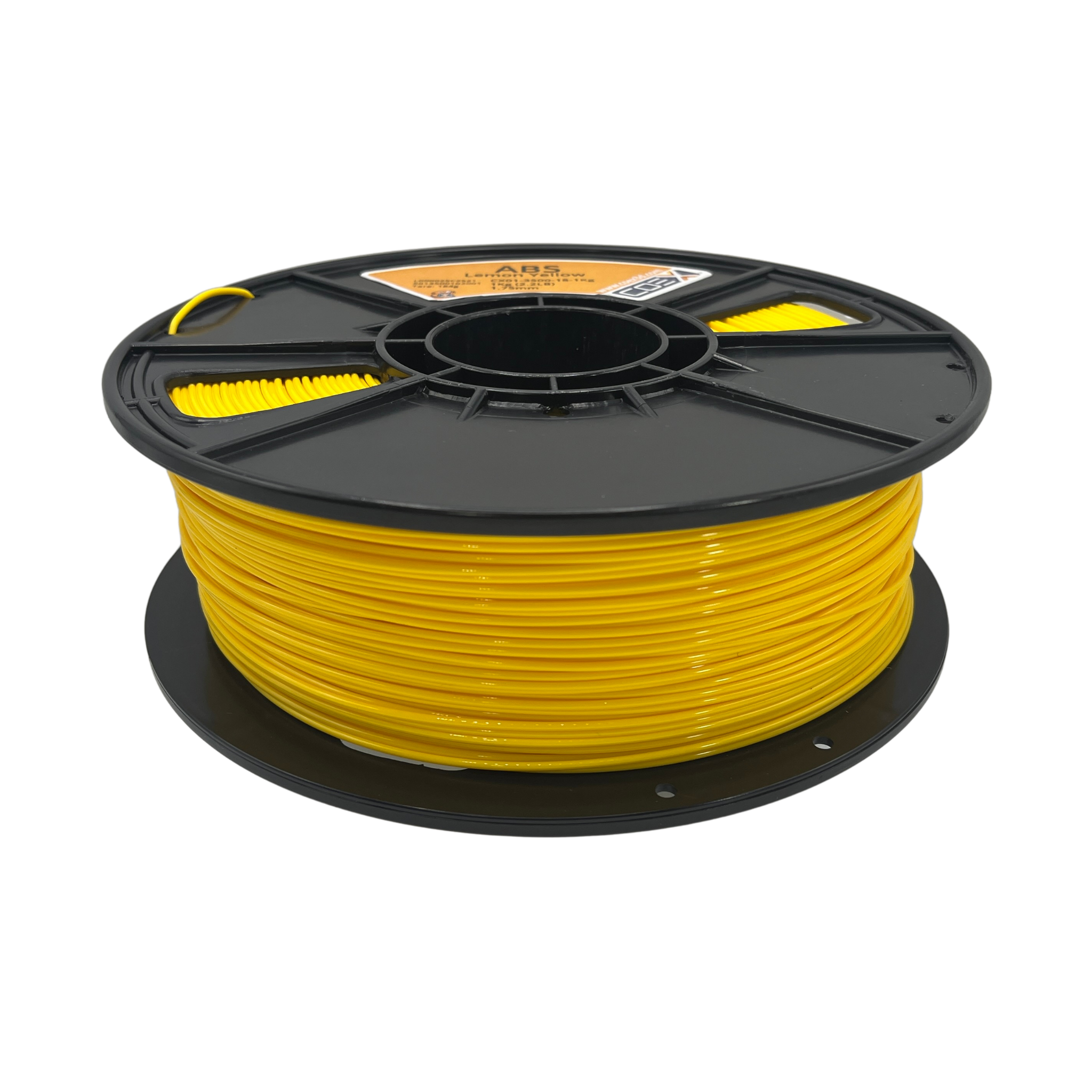
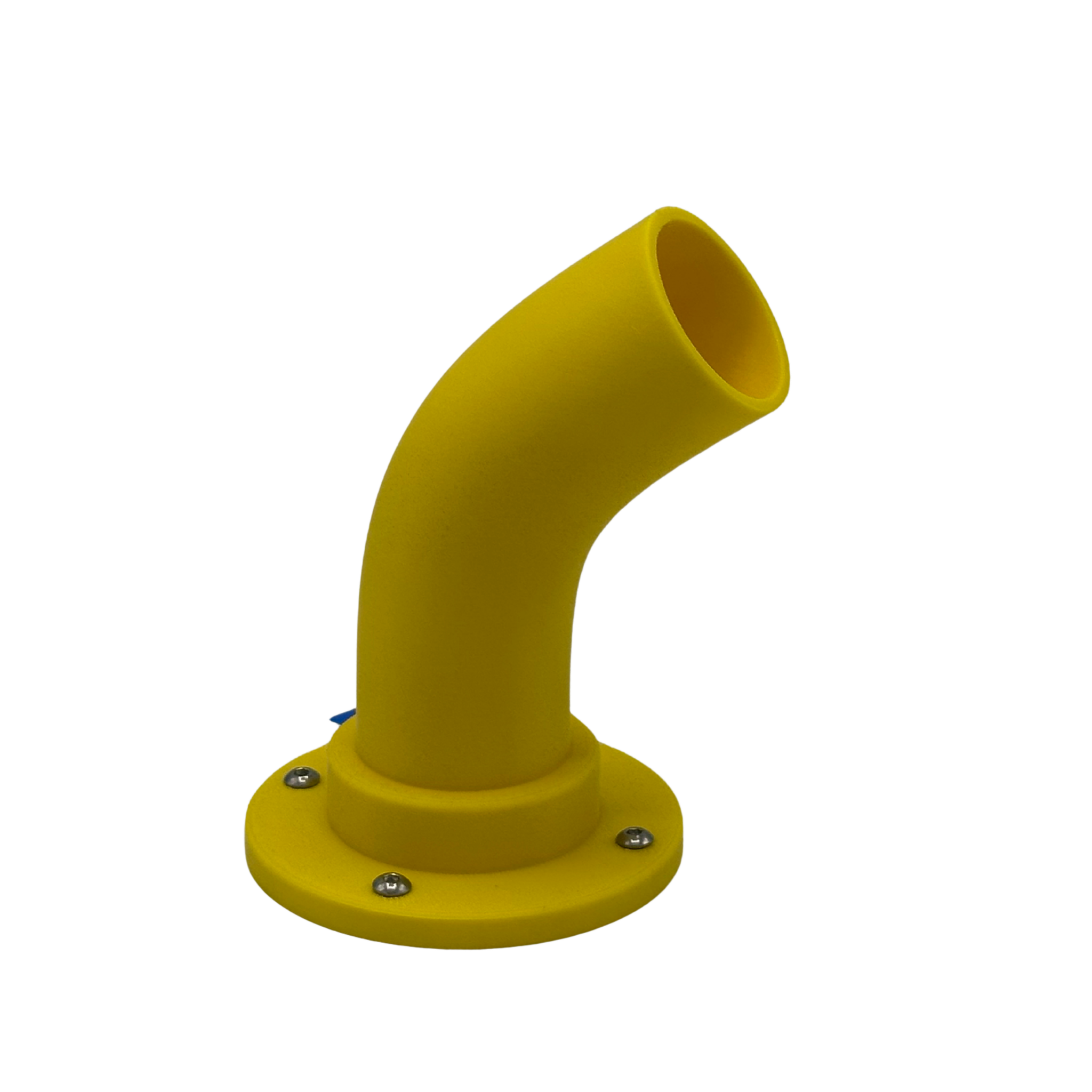


Lemon Yellow ABS is ABS (acrylonitrile butadiene styrene) for parts that take heat and impact: end-use tools, moving parts and parts under high mechanical stress. Manufacturers also use ABS in rapid prototyping to test a design's impact resistance and durability.
Key properties
- Stiff, impact-resistant and heat-resistant
- Holds structural integrity and detail
Printing notes
- Requires an enclosed 3D printer
- More technical to print than PLA or PETG, so it can be harder for new users
Specs
- Material: ABS
- Tolerance: ±0.03 mm (1.75 mm) · ±0.06 mm (2.85 mm)
- Other spool sizes available by request: contact us.
- Extruded, quality controlled and shipped from one plant in Green Bay, WI.
CX01 ABS Technical Data Sheet
ABS 3D Printer Filament
Acrylonitrile butadiene styrene (ABS) · Product code CX01 · 1.75 mm and 2.85 mm
Base resin: Acrylonitrile butadiene styrene (ABS)
Typical values for the base resin. Printed parts vary with print settings, orientation and moisture content.
Physical properties
| Property | Standard | Unit | Typical value |
|---|---|---|---|
| Mass density, 23 °C | ISO 1183 | g/cm³ | 1.03 |
| Melt flow index, 220 °C / 10 kg | ISO 1133 | ml/10 min | 13 |
| Melt flow index, 200 °C / 5 kg | ASTM D1238 | g/10 min | 1.1 |
| Mold shrinkage | ISO 294-4 | % | 0.4–0.7 |
| Rockwell hardness, R scale | ASTM D785 | 108 | |
| UL 94 flammability, 1.5 mm | UL 94 | HB |
Mechanical properties
| Property | Standard | Unit | Typical value |
|---|---|---|---|
| Tensile strength at yield, 50 mm/min | ISO 527 | MPa (psi) | 40 (5,800) |
| Tensile strength at break, 50 mm/min | ISO 527 | MPa (psi) | 30 (4,350) |
| Tensile elongation, 50 mm/min | ISO 527 | % | 35 |
| Flexural strength, 2 mm/min | ISO 178 | MPa (psi) | 58 (8,410) |
| Flexural modulus, 2 mm/min | ISO 178 | MPa (psi) | 1,800 (261,000) |
| Izod impact strength, notched, 23 °C | ISO 180/1A | kJ/m² | 34 |
| Izod impact strength, notched, −30 °C | ISO 180/1A | kJ/m² | 23 |
| Charpy impact strength, notched, 23 °C | ISO 179 | kJ/m² | 36 |
| Charpy impact strength, notched, −30 °C | ISO 179 | kJ/m² | 25 |
| Tensile strength at yield, 6 mm/min | ASTM D638 | MPa (psi) | 37.8 (5,470) |
| Tensile elongation, 6 mm/min | ASTM D638 | % | 30 |
| Flexural strength, 2.8 mm/min | ASTM D790 | MPa (psi) | 60.8 (8,800) |
| Flexural modulus, 2.8 mm/min | ASTM D790 | MPa (psi) | 2,160 (3.1 × 10⁵) |
| Izod impact strength, notched, 6.4 mm, 23 °C | ASTM D256 | J/m (ft·lb/in) | 314 (5.9) |
| Izod impact strength, notched, 3.2 mm, 23 °C | ASTM D256 | J/m (ft·lb/in) | 402 (7.5) |
Thermal properties
| Property | Standard | Unit | Typical value |
|---|---|---|---|
| Vicat softening temperature, 1 kg, 50 °C/h | ISO 306 | °C (°F) | 104 (219) |
| Vicat softening temperature, 5 kg, 50 °C/h | ISO 306 | °C (°F) | 96 (205) |
| Heat distortion temperature, 1.8 MPa, unannealed | ISO 75/A | °C (°F) | 82 (180) |
| Heat distortion temperature, 1.8 MPa, annealed | ISO 75/A | °C (°F) | 97 (207) |
| Vicat softening temperature, 1 kg, 50 °C/h | ASTM D1525 | °C (°F) | 103 (217) |
| Heat distortion temperature, 1.8 MPa, annealed | ASTM D648 | °C (°F) | 95 (203) |
| Heat distortion temperature, 1.8 MPa, unannealed | ASTM D648 | °C (°F) | 85 (186) |
Filament specifications
| Diameter | Nominal | Minimum | Maximum | Tolerance |
|---|---|---|---|---|
| 1.75 mm | 1.75 mm (0.0689 in) | 1.72 mm (0.0677 in) | 1.78 mm (0.0701 in) | ±0.03 mm (±0.0012 in) |
| 2.85 mm | 2.85 mm (0.1122 in) | 2.79 mm (0.1098 in) | 2.91 mm (0.1146 in) | ±0.06 mm (±0.0024 in) |
Recommended print settings
| Nozzle temperature | 245–265°C |
| Bed temperature | 90–110°C |
| Enclosure | An enclosure is required |
| Part cooling fan | 0–30% (off for the first layer) |
| Drying | Dry an opened spool at 80°C for 4–6 hours |
| Storage | Keep filament dry: store it sealed, and dry it again only after the spool has been exposed to air |
| Bed adhesion | use WELD3D, ABS slurry or Kapton tape |
www.coex3d.com · COEX LLC, 1228 Elizabeth St, Green Bay, WI 54302, USA · (920) 757-1055
Disclaimer: The technical data contained on this data sheet is furnished without charge or obligation and accepted at the recipient's sole risk. This data should not be used to establish specification limits or used alone as the basis of design. The data provided is not intended to substitute any testing that may be required to determine fitness for any specific use.
CX01 ABS Safety Data Sheet
ABS 3D Printer Filament
Acrylonitrile butadiene styrene (ABS) · Product code CX01
1. Identification
| Product identifier | ABS 3D Printer Filament |
| Product code | CX01 |
| Recommended use | 3D printing (FFF/FDM) filament, thermoplastic |
| Restrictions on use | Not specified |
| Supplier | COEX LLC, 1228 Elizabeth St, Green Bay, WI 54302, USA |
| Telephone | (920) 757-1055 |
| Emergency telephone | (920) 757-1055 (business hours) |
| Website | www.coex3d.com |
2. Hazard identification
| Classification | Classification according to Directive 67/548/EEC or 1999/45/EC: Not classified as hazardous (polymeric state). Classification according to Regulation (EC) N° 1272/2008 (CLP): Not classified as hazardous (polymeric state) |
| Label elements | Not labelled as hazardous |
| Hazards not otherwise classified | No data available |
| Other information | vPvB/PBT assessment: not available |
3. Composition / information on ingredients
| Chemical name | CAS No. | Weight % |
|---|---|---|
| Styrene Acrylonitrile Copolymer | 9003-54-7 | ≤ 95 |
| Carbon black | 1333-86-4 | ≤ 5.0 |
Maker: "Impurities Contributing to Hazard: None". Maker REACH info lists pre-registration/registration numbers for the monomers acrylonitrile, styrene and buta-1,3-diene.
4. First-aid measures
| Inhalation | In case of gases evolving from melted resin, move subject to fresh air. Treat symptomatically |
| Eye contact | In case of pellets or powder, flush with plenty of water for at least 15 minutes. Seek medical advice if any dust particles still remain. In case of gases evolving from melted resin of high temperature, flush with plenty of water for at least 15 minutes. Seek medical advice if necessary |
| Skin contact | In case of pellets or powder, wash with water. In case of smelt, wash affected skin area and clothing with plenty of (soap and) water. Seek medical advice |
| Ingestion | Induce vomiting. Rinse mouth with water. Seek medical advice if necessary |
| Most important symptoms | Dust: Skin irritation, eye irritations and redness |
| Note to physicians | Treat symptomatically. (Decontamination, vital functions) |
5. Fire-fighting measures
| Suitable extinguishing media | Suitable extinguishing agents: Water, foam, dry chemical powder |
| Special hazards | No data available |
| Protective equipment | Self-contained breathing apparatus |
| Further information | Dispose of fire debris and contaminated extinguishing water in accordance with official regulations. |
6. Accidental release measures
| Personal precautions | Spilled filament or pieces may cause a slipping hazard. Ensure adequate ventilation. |
| Environmental precautions | Do not flush into surface water or sanitary sewer system. Keep out of waterways. |
| Cleaning up | Pick up or sweep up and place in a suitable container for disposal. |
7. Handling and storage
| Safe handling | Measures to prevent fire: Prevent from fire around handling area. Measures to prevent aerosol and dust generation: maintain good housekeeping standards to prevent accumulation of dust. To avoid dust explosion resulting from the existence of powder, electrostatics eliminators and grounding should be fixed to such equipment as air transferring pipes, bag filters and hoppers. Use electrically conductive filters for bag filters. |
| Fire and explosion | Dust from grinding or sanding can form an explosive mixture with air. Take precautionary measures against static discharges. |
| Storage | Keep the material at a cool dry place. Protect from direct sunlight, rain and violent temperature fluctuation. Fire is inhibited around storage area. |
| Incompatibilities | not applicable |
8. Exposure controls / personal protection
| Exposure limits | Exposure Limits: None established |
| Engineering controls | Provide exhaust ventilation if dust or fumes are generated during processing. |
| Personal protection | Respiratory protection: Wear masks for cleaning molding machines. Hand protection: Heat-insulting gloves when handling molten form. Eye protection: Wear safety glasses for general purpose. Wear chemical goggles for cleaning molding machines. Skin and body protection: Gloves necessary for handling melted resin. Hygiene measures: Wash hands after handling |
| Hygiene | Do not eat or drink while working. Handle in accordance with good industrial hygiene and safety practice. |
9. Physical and chemical properties
| Appearance | Physical state: solid, granulate. Colour: Natural or off-white (resin as supplied) |
| Odor | Odourless or negligible |
| Odor threshold | Not applicable |
| pH | Not applicable |
| Melting temperature | Melting point / freezing point: not determined |
| Freezing point | No data available |
| Boiling point | Decomposes; not determined |
| Flash point | Flash point: 404 °C |
| Evaporation rate | Not applicable (solid) |
| Flammability | Not available |
| Explosive limits | No data available |
| Vapor pressure / vapor density | No data available |
| Density | Relative density (H2O=1): 1.03 - 1.10 g/cm³ |
| Solubility in water | Not soluble |
| Partition coefficient | No data available |
| Auto-ignition temperature | 466 °C |
| Decomposition temperature | > 300 °C |
| Viscosity | Not applicable (solid) |
| Oxidizing properties | Not oxidizing |
10. Stability and reactivity
| Reactivity | Non-reactive under normal handling and storage conditions |
| Chemical stability | Stable under normal handling and storage conditions |
| Hazardous reactions | No data available |
| Conditions to avoid | Avoid excessive heat, flames and all sources of ignition |
| Incompatible materials | not applicable |
| Hazardous decomposition products | not applicable. (Section 13: Inadequate incineration may generate toxic gases such as CO, HCN, AN and SM) |
11. Toxicological information
| Routes of exposure | Inhalation, ingestion, eye or skin contact. |
| Acute toxicity | Acute toxicity (oral): Lack of data. Acute toxicity (dermal): Lack of data. Acute toxicity (inhalative): Lack of data. Effects on or via lactation: Lack of data. Other information, Styrene: Harmful if inhaled. Causes damage to organs through prolonged or repeated exposure. Lung damages. May be fatal if swallowed and enters airways. Causes serious eye irritation. Causes skin irritation. Acrylonitrile: Toxic by inhalation, in contact with skin and if swallowed. May cause cancer. Suspected of damaging the unborn child. Causes skin irritation. May cause an allergic skin reaction. Causes serious eye damage. 1,3-Butadiene: May cause cancer. May cause genetic defects. Symptoms: Dust: Can cause skin, eye and respiratory tract irritation. The melted product can cause severe burns. Thermal treatment, Processing: Irritating to eyes, respiratory system and skin. In case of ingestion: Swallowing may cause gastrointestinal irritation and pain of guts. |
| Inhalation | Not inhalable in the form supplied. |
| Irritation | Skin corrosion/irritation: Lack of data. May cause irritations. Eye damage/irritation: Lack of data. May cause irritations. Dusts: Irritating to eyes, respiratory system and skin. |
| Sensitization, repeated dose, mutagenicity, carcinogenicity, reproductive toxicity | Sensitisation to the respiratory tract: Lack of data. Not to be expected. Skin sensitisation: Lack of data. Not to be expected. Germ cell mutagenicity/Genotoxicity: Lack of data. Not to be expected. Carcinogenicity: Lack of data. Not to be expected. Reproductive toxicity: Lack of data. Not to be expected. Specific target organ toxicity (single exposure): Lack of data. Specific target organ toxicity (repeated exposure): Lack of data. |
| Aspiration hazard | None expected. |
12. Ecological information
| Aquatic toxicity | Short-term aquatic toxicity: Based on available data on the constituents the classification criteria are not met. LC(50)mixture = 5.78 mg/l (additivity and summation method, toxicity information available for 92,5 % of the mixture). Long-term aquatic toxicity: Based on available data on the constituents the classification criteria are met and the mixture is therefore classified as Aquatic Chronic 1. NOECmixture = 0.0079 mg/l (additivity and summation method, toxicity information available for 78 % of the mixture). Mobility in soil: no data available. PBT/vPvB: No information available on the product as such. General information: Do not allow to enter into ground-water, surface water or drains. |
| Persistence and degradability | Biodegradation: Product is not readily biodegradable. The product is likely to persist in the environment. Effects in sewage plants: In sewage treatment plants it may be separated mechanically. |
| Bioaccumulation | To avoid bioaccumulation plastics should not be disposed in the sea or in other water environments. |
13. Disposal considerations
| Product | Dispose of in accordance with local, state and federal regulations. Check for recycling options. Do not release into the environment. |
| Packaging | Empty spools and packaging can be recycled if not contaminated. |
14. Transport information
| US DOT, IMDG, IATA/ICAO | ADR/RID, ADNR/ADN, IMDG, ICAO/IATA: UN number Not applicable. Proper Shipping Name: NOT REGULATED. Transport hazard class: Not applicable. Packing group: Not applicable. Environmental hazards: Not considered environmentally hazardous based on available data |
15. Regulatory information
| U.S. TSCA | No data available |
| SARA 313 | No data available |
16. Other information
| NFPA hazard codes | No data available |
| HMIS III rating | No data available |
| Issue date / revision | 10-27-2026 · Revision 2.0, supersedes Revision 1.0 (02-04-21). Rewritten in the 16-section OSHA format. |
| Prepared by | COEX LLC |
This data is based on the current state of our information and experience.
www.coex3d.com
Disclaimer: The safety data contained on this data sheet is furnished without charge or obligation and accepted at the recipient's sole risk. This data describes our product in terms of safety requirements. The data provided is not applicable as a warranty of product properties. It is the responsibility of the recipient to observe the existing legal regulations for the use of this product.
| Spools | Discount |
|---|---|
| 6+ | 5% off |
| 12+ | 10% off |
| 24+ | 15% off |