
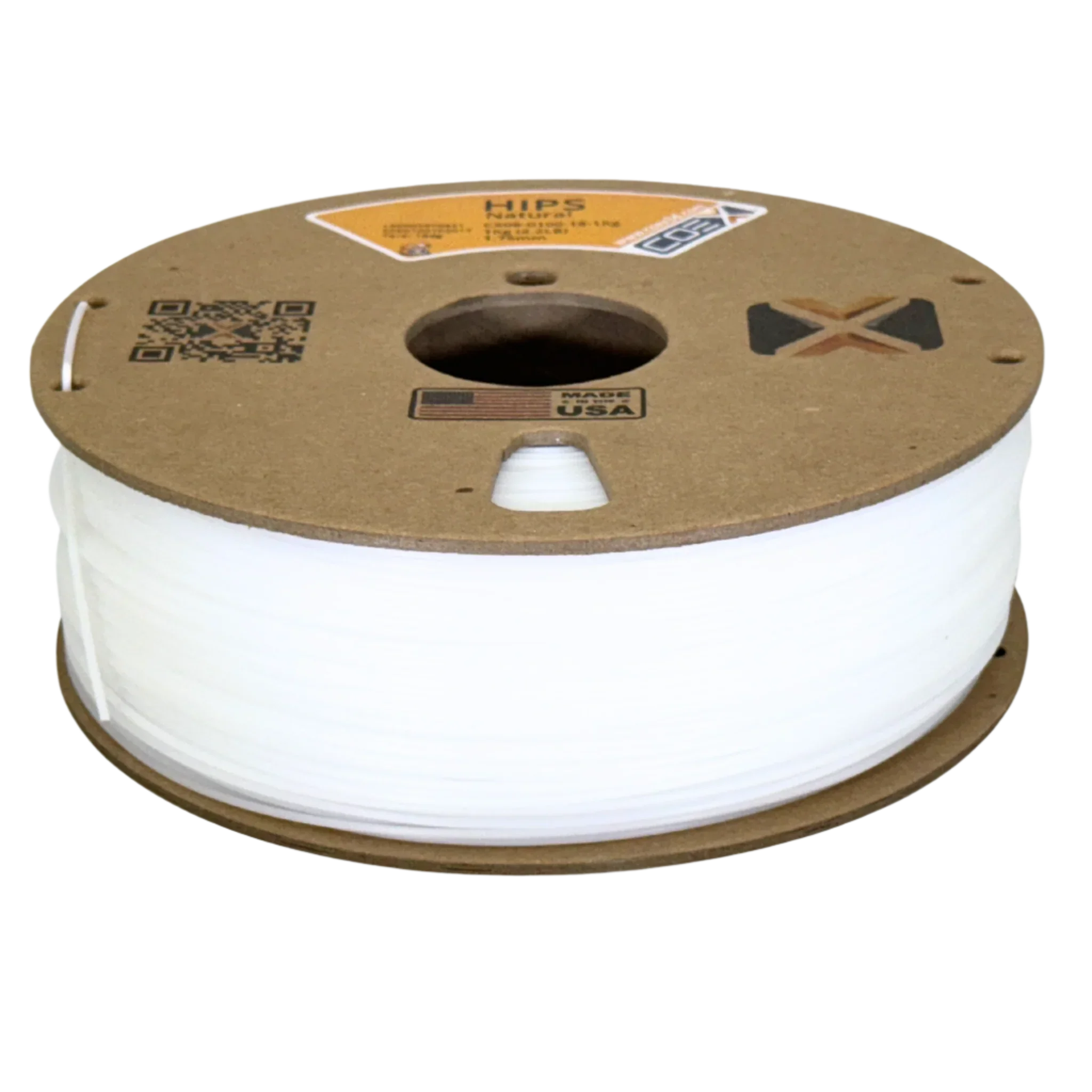

Natural HIPS (high impact polystyrene) is a dissolvable filament, often used as support material. Limonene solution removes it, so supports come off without scraping or cutting that could damage your print.
Specs
- Material: HIPS
- Tolerance: ±0.03 mm (1.75 mm) · ±0.06 mm (2.85 mm)
- Other spool sizes available by request: contact us.
- Extruded, quality controlled and shipped from one plant in Green Bay, WI.
CX06 HIPS Technical Data Sheet
HIPS 3D Printer Filament
High impact polystyrene (HIPS) · Product code CX06 · 1.75 mm and 2.85 mm
Base resin: High impact polystyrene (HIPS)
Typical values for the base resin. Printed parts vary with print settings, orientation and moisture content. Resin maker: typical properties, not to be considered specification limits.
Physical properties
| Property | Standard | Unit | Typical value |
|---|---|---|---|
| Melt flow index (200 °C/5 kg) | ASTM D-1238 | g/10 min | 2.8 |
| Specific gravity | ASTM D-792 | 1.04 | |
| Coefficient of linear thermal expansion (10⁻⁵) | ASTM D-696 | cm/cm/°C (in/in/°F) | 9 (5) |
| Rockwell hardness, R scale | ASTM D-785 | 107 | |
| Mold shrinkage (10⁻³) | ASTM D-955 | cm/cm (in./in.) | 4 to 8 |
| UL classification | UL 94 | HB (UL file E326906) |
Mechanical properties (injection molded)
| Property | Standard | Unit | Typical value |
|---|---|---|---|
| Tensile strength | ASTM D-638 | MPa (psi) | 27 (3,900) |
| Tensile rupture | ASTM D-638 | MPa (psi) | 25.5 (3,700) |
| Elongation | ASTM D-638 | % | 65 |
| Tensile modulus | ASTM D-638 | MPa (psi) | 1,900 (270,000) |
| Flexural strength | ASTM D-790 | MPa (psi) | 36 (5,200) |
| Flexural modulus | ASTM D-790 | MPa (psi) | 1,900 (275,000) |
| Izod impact @ 23 °C | ASTM D-256 | J/m (ft·lb/in) | 112 (2.1) |
| Izod impact @ 23 °C (compression molded) | ASTM D-256 | J/m (ft·lb/in) | 95 (1.8) |
Thermal properties
| Property | Standard | Unit | Typical value |
|---|---|---|---|
| Heat deflection temperature @ 264 psi | ASTM D-648 | °C (°F) | 79 (174) |
| Heat deflection temperature @ 66 psi | ASTM D-648 | °C (°F) | 89 (192) |
| Vicat softening temperature | ASTM D-1525 | °C (°F) | 101 (214) |
Filament specifications
| Diameter | Nominal | Minimum | Maximum | Tolerance |
|---|---|---|---|---|
| 1.75 mm | 1.75 mm (0.0689 in) | 1.72 mm (0.0677 in) | 1.78 mm (0.0701 in) | ±0.03 mm (±0.0012 in) |
| 2.85 mm | 2.85 mm (0.1122 in) | 2.79 mm (0.1098 in) | 2.91 mm (0.1146 in) | ±0.06 mm (±0.0024 in) |
Recommended print settings
| Nozzle temperature | 245–265 °C |
| Bed temperature | 80–100 °C |
| Enclosure | Necessary |
| Part cooling fan | Off for the first layer; 0–30% for general printing; up to 30% for bridges, overhangs and layers under 15 seconds |
| Drying | If needed, 65 °C for 2–4 hours |
www.coex3d.com · COEX LLC, 1228 Elizabeth St, Green Bay, WI 54302, USA · (920) 757-1055
Disclaimer: The technical data contained on this data sheet is furnished without charge or obligation and accepted at the recipient's sole risk. This data should not be used to establish specification limits or used alone as the basis of design. The data provided is not intended to substitute any testing that may be required to determine fitness for any specific use.
CX06 HIPs Safety Data Sheet
HIPS 3D Printer Filament
High impact polystyrene (HIPS) · Product code CX06
1. Identification
| Product identifier | HIPS 3D Printer Filament |
| Product code | CX06 |
| Recommended use | 3D printing (FFF/FDM) filament, thermoplastic |
| Restrictions on use | Not specified |
| Supplier | COEX LLC, 1228 Elizabeth St, Green Bay, WI 54302, USA |
| Telephone | (920) 757-1055 |
| Emergency telephone | (920) 757-1055 (business hours) |
| Website | www.coex3d.com |
2. Hazard identification
| Classification | Not a hazardous substance or mixture. (GHS classification in accordance with the OSHA Hazard Communication Standard, 29 CFR 1910.1200.) |
| Label elements | GHS label elements: Not a hazardous substance or mixture. |
| Hazards not otherwise classified | No data available |
| Other information | Eye contact: Not Available. Skin contact: Not Available. Inhalation: Not Available. Ingestion: Not Available. Additional physical information: Not Available. |
3. Composition / information on ingredients
| Chemical name | CAS No. | Weight % |
|---|---|---|
| Styrene, polymers | 9003-55-8 | >= 94 |
| White mineral oil (petroleum) | 8042-47-5 | <= 3 |
S2 3.1 Substance / Mixture: Not Applicable. The old COEX SDS listed only Styrene, 1,3-butadiene copolymer 9003-55-8 >= 94 %.
4. First-aid measures
| Inhalation | Remove Person to fresh air and keep at rest in a position comfortable for breathing. If unconscious, place in recovery position and seek medical advice. If symptoms persist, call a physician. |
| Eye contact | Remove contact lenses. Rinse cautiously with water for several minutes. Protect unharmed eyes. If eye irritation persists, consult a specialist. |
| Skin contact | No data available |
| Ingestion | Keep respiratory tract clear. Do not give milk or alcoholic beverages. Do not induce vomiting. Never give anything by mouth to an unconscious person. If symptoms persist, call a physician. |
| Most important symptoms | None known. Ingestion: May cause gastrointestinal blockage. |
| Note to physicians | Treat symptomatically. |
5. Fire-fighting measures
| Suitable extinguishing media | Suitable: In case of fire: Use water spray for extinction. Use dry chemical powder for extinction. Use carbon dioxide for extinction. Use foam for extinction. Unsuitable: Pneumatic conveying and other mechanical handling operations can generate combustible dust. To reduce the potential for dust explosions, do not permit dust to accumulate. Dense smoke is produced when product burns. |
| Special hazards | Hazardous combustion products: No hazardous combustion products are known. Unusual fire and explosion hazards: Provide appropriate exhaust ventilation at places where dust is formed. Further information: Standard procedure for chemical fires. Use extinguishing measures that are appropriate to local circumstances and the surrounding environment. |
| Protective equipment | Wear self-contained breathing apparatus for firefighting if necessary. |
| Further information | Dispose of fire debris and contaminated extinguishing water in accordance with official regulations. |
6. Accidental release measures
| Personal precautions | Spilled filament or pieces may cause a slipping hazard. Ensure adequate ventilation. |
| Environmental precautions | Do not flush into surface water or sanitary sewer system. Keep out of waterways. |
| Cleaning up | Pick up or sweep up and place in a suitable container for disposal. |
7. Handling and storage
| Safe handling | Technical measures: Store with proper labeling. Advice on protection against fire and explosion: Provide appropriate exhaust ventilation at places where dust is formed. Advice on safe handling: For personal protection see section 8. Smoking, eating and drinking should be prohibited in the application area. |
| Fire and explosion | Dust from grinding or sanding can form an explosive mixture with air. Take precautionary measures against static discharges. |
| Storage | Electrical installations / working materials must comply with the technological safety standards. Materials to avoid: No materials to be especially mentioned. No decomposition if stored and applied as directed. Special packaging rules: Store with proper labeling. |
| Incompatibilities | Not applicable |
8. Exposure controls / personal protection
| Exposure limits | White mineral oil (petroleum), CAS 8042-47-5: ACGIH TLV TWA (inhalable fraction) 5 mg/m3; OSHA Z-1 TWA (mist) 5 mg/m3; ACGIH TWA (inhalable particulate matter) 5 mg/m3; OSHA P0 TWA (mist) 5 mg/m3; NIOSH REL TWA (mist) 5 mg/m3; NIOSH REL ST (mist) 10 mg/m3. |
| Engineering controls | Provide exhaust ventilation if dust or fumes are generated during processing. |
| Personal protection | Respiratory protection: No personal respiratory protective equipment normally required. Eye protection: Safety glasses. Skin and body protection: Protective suit. Protective measures: Protective Clothing, Protective Glasses, Gloves. Hand protection: Consistent with general hygienic practice for any material, skin contact should be minimized. Use gloves with insulation for thermal protection, when needed. Use gloves to protect from mechanical injury. Selection of gloves will depend on the task. Hygiene measures: General industrial hygiene practice. |
| Hygiene | Do not eat or drink while working. Handle in accordance with good industrial hygiene and safety practice. |
9. Physical and chemical properties
| Appearance | Solid; granules; color: Clear |
| Odor | Odorless |
| Odor threshold | Not applicable |
| pH | Not applicable |
| Melting temperature | No data available |
| Freezing point | No data available |
| Boiling point | Decomposes; not determined |
| Flash point | Not applicable |
| Evaporation rate | Not applicable (solid) |
| Flammability | Upper/lower flammability or explosion limit: Not applicable |
| Explosive limits | No data available |
| Vapor pressure / vapor density | No data available |
| Density | Specific gravity: 1.04 (ASTM D792) |
| Solubility in water | No data available |
| Partition coefficient | No data available |
| Auto-ignition temperature | No data available |
| Decomposition temperature | No data available |
| Viscosity | Not applicable (solid) |
| Oxidizing properties | No data available |
10. Stability and reactivity
| Reactivity | No decomposition if stored and applied as directed. |
| Chemical stability | No decomposition if stored and applied as directed. |
| Hazardous reactions | Stable under recommended storage conditions. No hazards to be specially mentioned. |
| Conditions to avoid | No data available |
| Incompatible materials | Not applicable |
| Hazardous decomposition products | Decomposition products depend upon temperature, air supply and the presence of other materials. Processing may release fumes and other decomposition products. At temperatures exceeding melt temperatures, polymer fragments can be released. Fumes can be irritating. Decomposition products can include and are not limited to: Combustible gases. |
11. Toxicological information
| Routes of exposure | Inhalation, ingestion, eye or skin contact. |
| Acute toxicity | Acute toxicity: Not classified based on available information. Acute oral toxicity: Single dose oral LD50 has not been determined. Acute inhalation toxicity: The LC50 has not been determined. Acute dermal toxicity: Typical for this family of materials. Estimated LD50, Rabbit > 2,000 mg/kg. |
| Inhalation | Not inhalable in the form supplied. |
| Irritation | Skin corrosion/irritation: Not classified based on available information. Under normal processing conditions, material is heated to elevated temperatures; contact with the material may cause thermal burns. Serious eye damage/eye irritation: Not classified based on available information. Solid or dust may cause irritation or corneal injury due to mechanical action. Elevated temperatures may generate vapor levels sufficient to cause eye irritation. Effects may include discomfort and redness. |
| Sensitization, repeated dose, mutagenicity, carcinogenicity, reproductive toxicity | Respiratory or skin sensitization: Not classified. Germ cell mutagenicity: Not classified. Carcinogenicity: Not classified; no component present at levels >= 0.1% is identified as probable, possible or confirmed human carcinogen by IARC, is on OSHA's list of regulated carcinogens, or is identified as a known or anticipated carcinogen by NTP. Reproductive toxicity: Not classified. STOT single exposure: Not classified. STOT repeated exposure: Not classified. Repeated dose toxicity: Not classified. Aspiration toxicity: Not classified. |
| Aspiration hazard | None expected. |
12. Ecological information
| Aquatic toxicity | Styrene, polymers: LL50 (Leuciscus idus) > 10,000 mg/l 96 h; LC50 (Lepomis macrochirus) > 10,000 mg/l 96 h; LL50 (Oncorhynchus mykiss) > 100 mg/l 96 h; LL50 (Daphnia magna) > 100 mg/l. Not expected to be acutely toxic to aquatic organisms. White mineral oil (petroleum): practically non-toxic to aquatic organisms on an acute basis (LC50/EC50/EL50/LL50 > 100 mg/L in the most sensitive species tested). Mobility in soil: No data available. Ozone-depletion potential: this product neither contains, nor was manufactured with a Class I or Class II ODS as defined by the U.S. Clean Air Act Section 602. |
| Persistence and degradability | Styrene, polymers: This water-insoluble polymeric solid is expected to be inert in the environment. White mineral oil (petroleum): Based on stringent OECD test guidelines, this material cannot be considered as readily biodegradable. However, these results do not necessarily mean that the material is not biodegradable under environmental conditions. |
| Bioaccumulation | White mineral oil (petroleum): Species: Fish. Bioconcentration factor (BCF): 1,900. Method: Estimated. Bioconcentration potential is high (BCF > 3000 or Log Pow between 5 and 7). |
13. Disposal considerations
| Product | Dispose of in accordance with local, state and federal regulations. Check for recycling options. Do not release into the environment. |
| Packaging | Empty spools and packaging can be recycled if not contaminated. |
14. Transport information
| US DOT, IMDG, IATA/ICAO | UNRTDG, IATA-DGR, IMDG-Code, 49 CFR: Not regulated as a dangerous good. Transport in bulk according to Annex II of MARPOL 73/78 and the IBC Code: Not applicable for product as supplied. Special precautions for user: Not applicable. |
15. Regulatory information
| U.S. TSCA | All components listed on TSCA inventory. |
| SARA 313 | SARA 313: This material does not contain any chemical components with known CAS numbers that exceed the threshold (De Minimis) reporting levels established by SARA Title III, Section 313. SARA 311/312 Hazards: No SARA Hazards. SARA 304 and 302: no components with an EHS RQ/TPQ. |
| California Prop 65 | WARNING: This product contains a chemical(s), which is/are known to the State of California to cause cancer. For more information go to www.P65Warnings.ca.gov. In April 2016, the Office of Environmental Health Hazard Assessment's (OEHHA) Proposition 65 Department proposed an NSRL of 27 g/day for styrene. The objective of the warning statement above is to comply with the Prop 65 statute. Styrene 100-42-5, Ethylbenzene 100-41-4. (Text as printed by the resin maker.) |
16. Other information
| NFPA hazard codes | NFPA 704: Health 0, Flammability 1, Instability 0 (no special hazard) (read from the diagram on S2 page 11) |
| HMIS III rating | HMIS IV: Health 0 (no chronic hazard, shown as "/"), Flammability 1, Physical hazard 0 (read from the diagram on S2 page 11) |
| Issue date / revision | 10-27-2026 · Revision 2.0, supersedes Revision 1.0 (02-04-21). Rewritten in the 16-section OSHA format. |
| Prepared by | COEX LLC |
This data is based on the current state of our information and experience.
www.coex3d.com
Disclaimer: The safety data contained on this data sheet is furnished without charge or obligation and accepted at the recipient's sole risk. This data describes our product in terms of safety requirements. The data provided is not applicable as a warranty of product properties. It is the responsibility of the recipient to observe the existing legal regulations for the use of this product.
| Spools | Discount |
|---|---|
| 6+ | 5% off |
| 12+ | 10% off |
| 24+ | 15% off |