
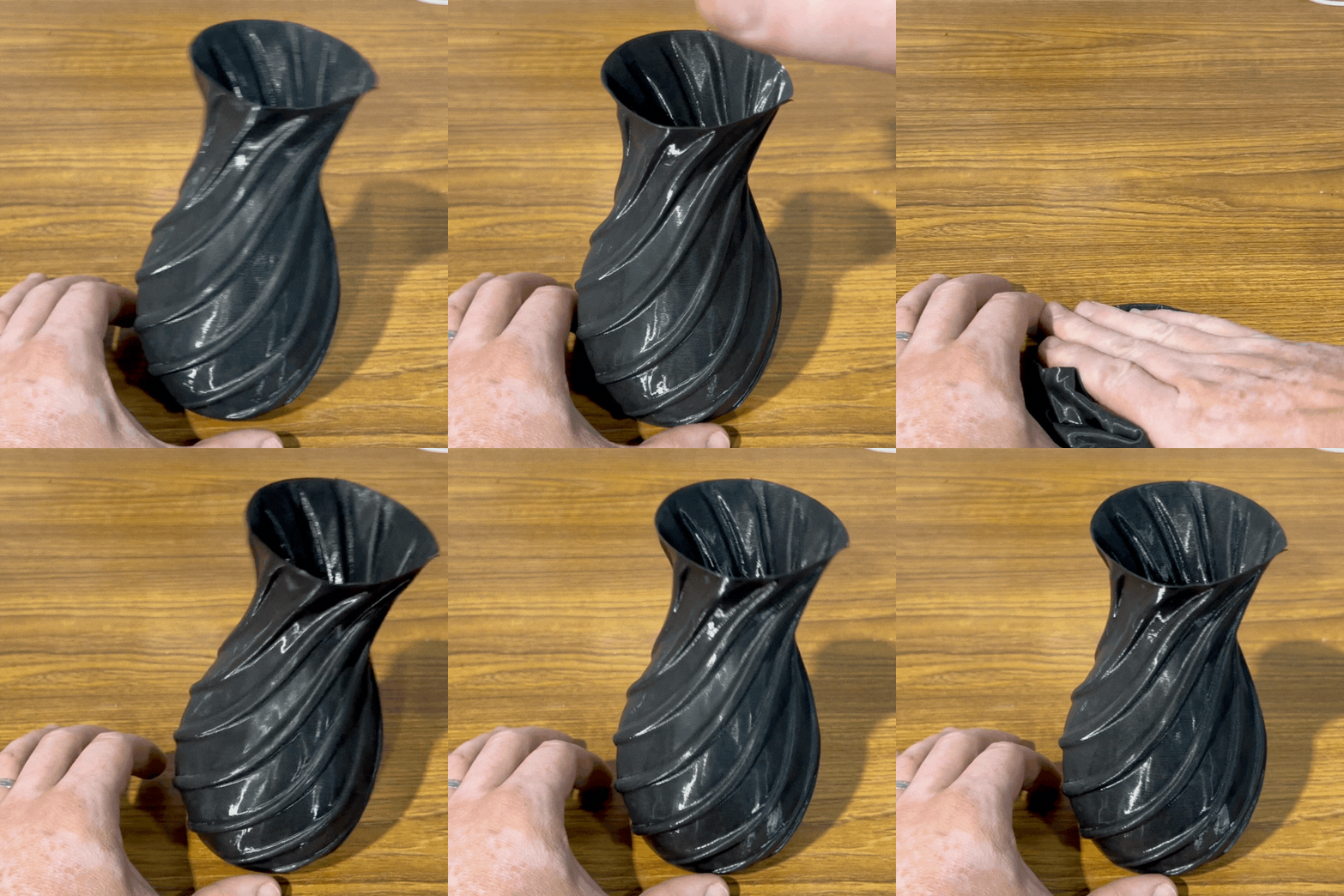
Introduction
60A Shore hardness TPU (Thermoplastic Polyurethane) is one of the softest flexible filaments available for FDM 3D printing. With a rubber-like feel and exceptional elasticity, it opens up a world of possibilities — but it also demands patience, precision, and the right setup. In this post, we'll explore the key benefits and challenges of working with 60A TPU.
What Is 60A TPU?
Shore hardness is a measure of a material's resistance to permanent indentation. At 60A, TPU is extremely soft and pliable — comparable to a soft rubber eraser or a gel insole. Coex 3D is proud to produce CoexFlex™ 60A TPU which is ideal for applications where flexibility, grip, and impact absorption are critical.
Benefits of Printing 60A TPU
1. Exceptional Flexibility and Elasticity
60A TPU can stretch significantly without tearing and returns to its original shape. This makes it perfect for gaskets, seals, grips, wearables, and any part that needs to flex or compress repeatedly.
2. Outstanding Impact Resistance
Parts printed in 60A TPU absorb shock extremely well, making them ideal for protective covers, bumpers, and vibration-dampening components.
3. Excellent Layer Adhesion
TPU generally bonds well between layers, resulting in parts that are strong in all directions — a significant advantage over more brittle materials like PLA or PETG.
4. Chemical and Abrasion Resistance
60A TPU holds up well against oils, greases, and many common chemicals, and its soft surface resists wear over time — a big plus for functional end-use parts.
5. Wide Range of Applications
From custom orthotics and phone cases to robotic grippers and industrial seals, the softness of 60A TPU makes it uniquely suited for applications that rigid filaments simply can't handle.
Challenges of Printing 60A TPU
1. Difficult to Feed Through a Bowden Setup
The softness that makes 60A TPU so useful also makes it prone to buckling and jamming in Bowden-style extruders. A direct drive extruder is strongly recommended — and in many cases, nearly essential — for reliable results.
2. Very Slow Print Speeds Required
60A TPU must be printed slowly, typically between 10–25 mm/s. Printing too fast causes the filament to compress, buckle, or under-extrude. Patience is key.
3. Stringing and Oozing
Soft TPU tends to ooze during travel moves, leading to stringing. Dialing in retraction settings is tricky — too much retraction can cause jams, while too little leads to messy prints. Minimizing travel moves through smart part orientation and slicer settings helps.
4. Bed Adhesion Can Be Tricky
While TPU generally sticks well to PEI and glass beds, very soft grades like 60A can be difficult to remove without deforming the part. Using a release agent or a textured surface can help balance adhesion and release.
5. Slicer Settings Need Careful Tuning
Standard slicer profiles for flexible filaments often aren't optimized for 60A. You'll likely need to experiment with temperature, flow rate, retraction, and cooling to find the sweet spot for your specific printer and filament brand. Coex 3D has done most of the thinking for you and can provide specific slicer settings to help you overcome some of the challenges inherent with ultra soft filaments.
6. Limited Compatibility with Multi-Material Setups
The extreme softness of 60A TPU makes it challenging to use in multi-material or multi-extruder systems, where filament path geometry is less forgiving.
Tips for Success with 60A TPU
- Use a direct drive extruder — this is the single biggest factor in print success.
- Print slow — start at 15 mm/s and work up from there.
- Disable or minimize retraction — try 0–1mm retraction to start.
- Keep the filament dry — TPU is hygroscopic and moisture causes bubbling and poor surface quality. Store it in a sealed container with desiccant.
- Use a hardened or geared extruder — soft filaments can wear out standard extruder gears over time.
- Experiment with temperature — most 60A TPU prints well between 220–240°C, but your brand may vary.
Conclusion
60A TPU is a remarkable material that unlocks applications no rigid filament can match. The challenges are real, but with the right printer setup and a willingness to tune your settings, the results are well worth the effort. Whether you're prototyping a custom grip, engineering a flexible seal, or creating a wearable component, 60A TPU delivers performance that's hard to beat.
Have questions about printing flexible filaments? Reach out to the COEX 3D team — we're here to help you get the most out of every spool.