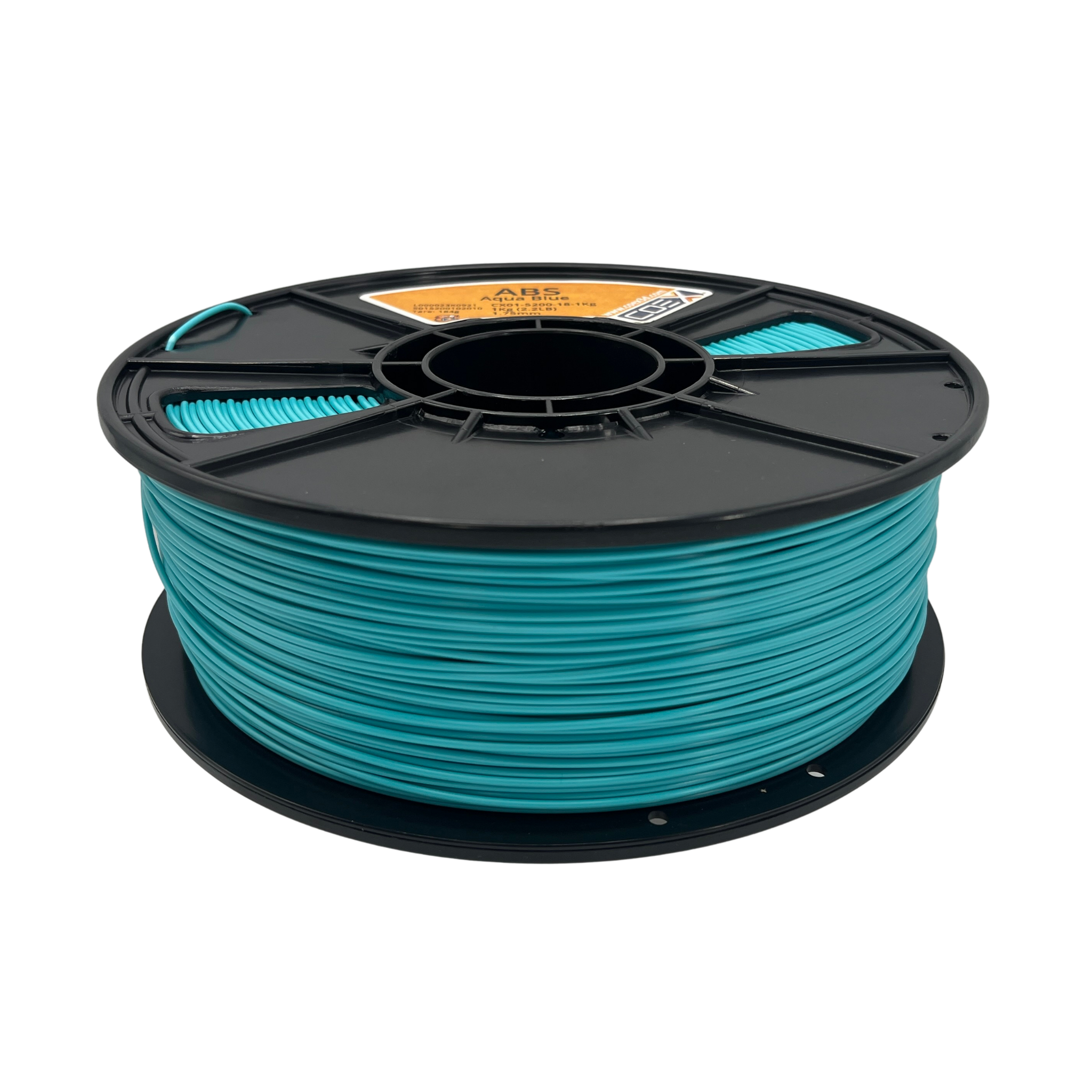
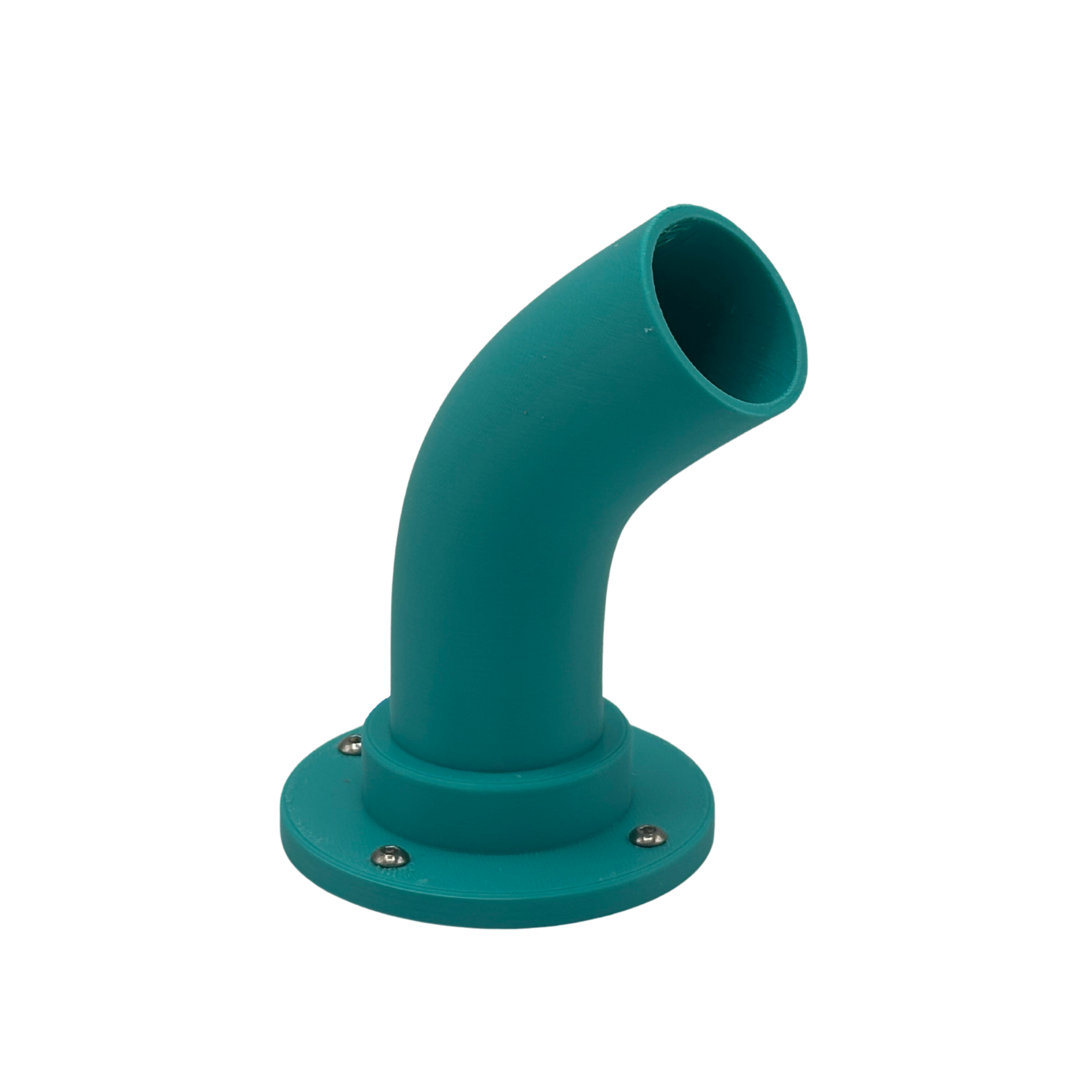
Aquablaues ABS

Aquablaues ABS

ABS-Filament ist ein thermoplastisches 3D-Druckerfilament (ABS), was für Acrylnitril-Butadien-Styrol steht . Es lässt sich beim Erhitzen leicht formen und härtet beim Abkühlen gleichmäßig aus. ABS-Filament wird in verschiedenen Fertigungsindustrien für Teile verwendet, die strukturelle Integrität und Detailtreue erfordern, und ist ideal für Verschleißprojekte. Es wird häufig in Rapid-Prototyping- und additiven Fertigungsumgebungen verwendet, um die Schlagfestigkeit und Haltbarkeit von Produkten zu testen. Es ist auch bei 3D-Druck-Bastlern beliebt, die 3D-Druck zu Hause oder auf einer lokalen Maker Faire nutzen. Dieses 3D-Druckerfilament ist in verschiedenen Farben und mit einem Durchmesser von 1,75 und 2,85 mm erhältlich und wird in den Gewichten 500 g, 5 lbs, 15 lbs und 1 kg geliefert.

Im Gegensatz zu PLA- und PETG-Filamenten ist ABS etwas technischer und kann für neue 3D-Druckerbenutzer eine größere Herausforderung darstellen und erfordert die Verwendung eines geschlossenen 3D-Druckers. ABS ist ein steifes 3D-Druckmaterial und stoß- und hitzebeständig. Zu den üblichen Anwendungen für ABS gehören Endverbrauchswerkzeuge, bewegliche Teile und Teile, die hohen mechanischen Belastungen standhalten müssen.

Technischer Druckleitfaden – COEX ABS

1. Wesentliche Hinweise

  • Halten Sie das Filament trocken – lagern Sie es ordnungsgemäß und trocknen Sie es vor der Verwendung.
  • Bei Bedarf 3 Stunden oder länger bei 75 °C trocknen
  • Einschließung ist notwendig
  • Verwenden Sie einen etwas höheren Z-Offset als PLA (+0,05 mm).
  • Aktivieren Sie „Überqueren von Perimetern vermeiden“, um das Stringing zu reduzieren
  • Erwägen Sie die Verwendung der Option „Wischen beim Einfahren“
  • Aktivieren Sie „Verlangsamen für kleine Bereiche“.
  • Drucken Sie Außenwände langsamer für eine bessere Qualität
  • Verwenden Sie für kleine Teile eine Mindestschichtzeit von 30 Sekunden
  • Erwägen Sie die Verwendung von „Extra Prime Amount“ nach dem Rückzug

2. Temperatureinstellungen

Betttemperatur: 80-100°C

  • Waschen Sie das Bett häufig, um eine gute Haftung zu gewährleisten. Verwenden Sie Spülmittel und spülen Sie es gründlich ab, um Öle zu entfernen.
  • Verwenden Sie bei Bedarf Betthaftungsprodukte (Klebestift, WELD3D )
  • Verwenden Sie die Krempe für hohe oder große Drucke
  • Halten Sie die Umgebungstemperatur stabil

Extrudertemperatur: 245-265°C

3. Grundlegende Parameter

Düse Schichthöhe Linienbreite Volumetrische Geschwindigkeit Temperatur
0,4 mm 0,2 mm 0,42 mm 14,0 mm³/s 250 °C
0,6 mm 0,3 mm 0,62 mm 31,5 mm³/s 255 °C
0,8 mm 0,4 mm 0,82 mm 56,0 mm³/s 260 °C
1,0 mm 0,5 mm 1,02 mm 87,5 mm³/s 265 °C


4. Geschwindigkeitseinstellungen

0,4-mm-Düse (Volumengeschwindigkeit: 14,0 mm³/s)

Linientyp Prozentsatz Geschwindigkeit
Äußerer Umfang 50 % 83,33 mm/s
Interne Umfänge 75 % 125,00 mm/s
Füllung 100 % 166,67 mm/s
Oben/Unten 60 % 100,00 mm/s
Erste Schicht 30 % 50,00 mm/s


0,6-mm-Düse (Volumengeschwindigkeit: 31,5 mm³/s)

Linientyp Prozentsatz Geschwindigkeit
Äußerer Umfang 50 % 84,68 mm/s
Interne Umfänge 75 % 127,02 mm/s
Füllung 100 % 169,35 mm/s
Oben/Unten 60 % 101,61 mm/s
Erste Schicht 30 % 50,81 mm/s


0,8-mm-Düse (Volumengeschwindigkeit: 56,0 mm³/s)

Linientyp Prozentsatz Geschwindigkeit
Äußerer Umfang 50 % 85,37 mm/s
Interne Umfänge 75 % 128,05 mm/s
Füllung 100 % 170,73 mm/s
Oben/Unten 60 % 102,44 mm/s
Erste Schicht 30 % 51,22 mm/s


1,0-mm-Düse (Volumengeschwindigkeit: 87,5 mm³/s)

Linientyp Prozentsatz Geschwindigkeit
Äußerer Umfang 50 % 85,78 mm/s
Interne Umfänge 75 % 128,68 mm/s
Füllung 100 % 171,57 mm/s
Oben/Unten 60 % 102,94 mm/s
Erste Schicht 30 % 51,47 mm/s


4. Rückzugseinstellungen

WICHTIG: Stellen Sie die Fahrgeschwindigkeit auf das Maximum ein, das Ihre Maschine zulässt (200–500 mm/s). Schnellere Bewegungen verkürzen die Filamentaustrittszeit und minimieren die Fadenbildung.

Düse Distanz Geschwindigkeit Z-Hop
0,4 mm 1,0–1,5 mm 40 mm/s 0,2 mm
0,6 mm 1,0–1,5 mm 40 mm/s 0,2 mm
0,8 mm 1,0–1,5 mm 40 mm/s 0,2 mm
1,0 mm 1,0–1,5 mm 40 mm/s 0,2 mm

6. Kühleinstellungen

Kühlkonfiguration:

    • Erste Schicht: 0 % (Ventilator aus)
    • Allgemeiner Druck: 100 % Basislüftergeschwindigkeit
    • Brücken und Überhänge: 100 % Lüftergeschwindigkeit
    • Schichten < 15 Sekunden: 100 % Lüftergeschwindigkeit

7. Anleitung zur Fehlerbehebung

Problem Lösung
Unregelmäßige Extrusion

1. Trocknen Sie das Filament

2. Überprüfen Sie den Extruder

3. Geschwindigkeit reduzieren

Schlechte Haftung

1. Trocknen Sie das Filament

2. Verwenden Sie Klebstoff

3. Passen Sie die erste Ebene an

Bespannung

1. Trocknen Sie das Filament

2. Rückzug einstellen

3. Reisegeschwindigkeit erhöhen

4. Temperatur prüfen

BITTE BEACHTEN: Diese Druckparameter sind erste Empfehlungen, die auf unseren Erfahrungen basieren. Sie müssen möglicherweise je nach 3D-Drucker, Umgebungsbedingungen und Geometrie des zu druckenden Teils angepasst werden. Verwenden Sie diese Einstellungen als Ausgangspunkt und optimieren Sie sie entsprechend Ihren spezifischen Anforderungen.

Coex 3D Filament Slicer Profiles

CX01 ABS Technical Data Sheet

Technical Data Sheet: CX01 ABS SERIES 3D PRINTING FILAMENT

TDS Rev 2.0

BASE RESIN: CHIMEI General ABS POLYLAC Ultra-High Impact Strength

Physical Properties

PropertyStandardUnitTypical Value
Specific Gravity - DensityASTM D792g/cm³1.03
Melt Density @220°C, 10KGASTM D1133g/10 min13
UL Flammability Class. @1.5mmUL 94N/A94HB

Mechanical Properties

PropertyStandardUnitTypical Value
Tensile Yield StrengthASTM D638MPa40
Tensile ModulusASTM D638MPa2350
Tensile ElongationASTM D638%35
Flexural StressISO 178MPa58
Notched Izod ImpactASTM D256J/m285
Shrinkage Rate < 1%ASTM D955mm/mm0.40 - 0.70%

Thermal Properties

PropertyStandardUnitTypical Value
Glass Transition Temperature (Tg)DSC°C105
Heat Distortion Temp @ 0.45MPaASTM D648°C85
Decomposition TemperatureASTM 3418°C300

SPECIFICATIONS

Filament Size:1.75mm(in)2.85mm(in)
MIN Diameter:1.72mm0.0677 in2.79mm0.1098 in
MAX Diameter:1.78mm0.0701 in2.91mm0.1146 in
Tolerance+/- .03mm+/- 0.0012 in+/- .06mm+/- 0.0024 in

CERTIFICATIONS

ROHS compliant to (2011/65/EU), 2003/11/EC, TCO'07, Blue Angel and SONY Std. (SS-00259)

NSF/ANSI/CAN 61 Drinking Water System Components

UL/C-UL Certified Yellow Card E56070

Printed Specimen Conditions

Printer:Open Source FDM/FFF
Nozzle:0.4mm
Layer Height:0.25mm
Infill:100%, +/-45°
Extrusion Temp:240°C
Bed Temp:90°C
Specimen Orientation:XY Flat
Unannealed

Disclaimer: The technical data contained on this data sheet is furnished without charge or obligation and accepted at the recipient's sole risk. This data should not be used to establish specifications limits or used alone as the basis of design. The data provided is not intended to substitute any testing that may be required to determine fitness for any specific use.

Download TDS (PDF)

CX01 ABS Safety Data Sheet

Material Safety Data Sheet: CX01 ABS SERIES 3D PRINTING FILAMENT

MSDS Rev 1.0

BASE RESIN: CHIMEI General ABS POLYLAC Ultra-High Impact Strength

1. Identification of the substance/preparation and of the company

1.1 Trade name:Coex ABS 3D printer filament
1.2 Use of the product:3D printer filament, thermoplastic polymer
1.3 Supplier:Coex
660 Corporate WAY
Pulaski, WI 54162
Phone: (920) 757-1055

2. Hazards identification

2.1 Classification:Combustible Dust
2.2 Special advice on hazards:May form combustible dust concentrations in air. While this product may not be a combustible dust as sold, further processing or handling may form combustible dust concentrations in air.

3. Composition / information on ingredients

3.1 Chemical characteristics:

CAS #Hazardous ComponentsConcentration
9003-54-7Styrene Acrylonitrile Copolymer<=95 %
1333-86-4Carbon black<=5.0 %

4. First-aid measures

4.1 On skin contact:In case of contact with molten polymer immediately cool the skin with cold water. Medical aid may be required to remove adhering material and for treatment of burns.
4.2 After inhalation:Remove from exposure and move to fresh air immediately. If not breathing, give artificial respiration. If breathing is difficult, give oxygen. Get medical aid.
4.3 On ingestion:If swallowed, wash out mouth with water provided person is conscious. Call a physician.
4.4 On eyes contact:In case of contact, immediately flush eyes with copious amounts of water for at least (15) minutes.

5. Fire-fighting measures

5.1 Suitable fire extinguishing media:Water spray and foam. Water is the best extinguishing medium.
5.2 Special exposure hazards:Emits toxic fumes under fire conditions. Approved positive pressure demand breathing apparatus (SCBA) and protective clothing should be used for all fires.
5.3 Special protective equipment:Self-contained breathing apparatus
5.4 Remark:Carbon dioxide and carbon monoxide generated when the material burns. Combustible Dust may form during material transfer. Estimated Dust Explosion Class = ST2; Kst estimated (bar.m/s): >200 -

6. Accidental release measures

6.1 Personal precautions:Use suitable protective clothing. Avoid eye contact and inhalation of dusts. Keep ignition sources away.
6.2 Methods for cleaning up:Vacuum or sweep up material and place into a suitable disposal container.

7. Handling and storage

7.1 Handling:Avoid contact with molten polymer. Avoid generation of dust and electrostatic charge.
7.2 Storage:Protect against moisture. Store cool and keep packaging closed when not in use. Avoid sources of ignition.

8. Exposure controls/ personal protection

8.1 Technical safety measures:Use with adequate ventilation. Minimize dust generation and accumulation as combustible dust mixtures may be formed.
8.2 Personal safety equipment:Use adequate safety equipment, e.g. protective clothing, eye protection glasses, heat protection gloves. In case of dust formation wear mask with particle filter.
8.3 Work hygiene:No eating or drinking during working. Avoid contact of hot material with the skin. Avoid breathing dust and vapors.

9. Physical and chemical properties

9.1 Form:Spool
9.2 Color:Various
9.3 Odor:Almost Odorless
9.4 Melting Temperature:250 °C
9.5 Oxidizing properties:Not self-igniting / flammable
9.6 Explosions limits:Class = ST2
9.7 Density:1.27 g/cm³
9.8 Solubility in water:Insoluble

10. Stability and reactivity

10.1 Stability:The product is stable at recommended storage conditions.
10.2 Conditions to be avoided:Stable under recommended conditions of storage and handling.
10.3 Substances to be avoided:No special recommendations.
10.4 Hazardous decomposition products:Processing fumes evolved at recommended processing conditions may include trace levels of low molecular weight hydrocarbon fragments, carbon dioxide, carbon monoxide and Irritating fumes and gases.

11. Toxicological information

11.1 Local irritation:No data available.
11.2 Other remarks:No data available.

12. Ecological information

12.1 Ecological info:This product is not classified as environmentally hazardous. However, this does not exclude the possibility that large or frequent spills can have a harmful or damaging effect on the environment.
12.2 Biological degradation:No data available.
12.3 Bioaccumulation:This product will not readily bioaccumulate due to its insolubility in water.

13. Disposal considerations

13.1 Product:Chemical waste generators must determine whether a discarded chemical is classified as a hazardous waste. US EPA guidelines for the classification determination are listed in (261) CFR Parts (261.3). Additionally, waste generators must consult state and local hazardous waste regulations to ensure complete and accurate classification. RCRA P-Series: None listed. RCRA U-Series: None listed.
13.2 Uncleaned packaging:Packaging material has to be emptied completely and disposed in accordance with the regulations. Packaging can be recycled if not contaminated.

14. Transport information

14.1 Transport regulations:Not classified as hazardous under transport regulations DOT, ICAO/IATA, IMDG/GGVSee, ICAO/IATA

15. Regulatory information

15.1 EPA regulations: This material meets the EPA 'Hazard Categories' defined for SARA Title III Sections 311/312 as indicated:

  • Acute (immediate) Health Hazard: No
  • Chronic (delayed) Health Hazard: No
  • Fire Hazard: Yes
  • Sudden Release of Pressure Hazard: No
  • Reactive Hazard: No

16. Other information

This data is based on the current state of our information and experience. This safety data sheet describes our product in terms of safety requirements. Preceding data is not applicable as a warranty of product properties. It is the responsibility of the recipient to observe the existing legal regulations for the use of this product.

Disclaimer: The safety data contained on this data sheet is furnished without charge or obligation and accepted at the recipient's sole risk. This data describes our product in terms of safety requirements. The data provided is not applicable as a warranty of product properties. It is the responsibility of the recipient to observe the existing legal regulations for the use of this product.

Download SDS (PDF)

Aquablaues ABS

Einsparung $2.00
SKU: CX01-5200-18-1KG
Keine Bewertungen

Durchmesser: 1,75 mm
Gewicht: 1 kg
Preis:
Sonderpreis$28.00 Normalpreis$30.00
Lagerbestand:
Verfügbar (20 Stück), versandbereit

You may also like

Recently viewed